Sunday, 17 June 2018

Intense weather and silver linings


Intense weather and silver linings

Climate change and global warming are hot topics of discussion around the world. Not surprisingly, it was an agenda item for the recent G7 Summit in Quebec.  The implications and impact continue to perpetuate dialogue as scientific and political sectors keep trying to understand and address inevitable consequences for thousands of people and hundreds of communities universally.   Extreme weather patterns appear sporadically in so many places. Families and civic infrastructures experience havoc and loss from the effects of severe storms, drought, floods, hurricanes, erupting volcanoes, etc.

Arriving in Kenya in early 2017, the relentless high temperatures were causing intense drought which meant poor crops, loss of human and animal life, and accelerating poverty. Fast forward twelve months and the environmental pendulum has swung the other way to excessive rain falls instigating destructive flooding. Who would have thought?

A few weeks ago, a dam burst in one Kenyan town, due to substantial rainfall, resulting in the loss of many lives and substantial ruin of property. A news story detailed how the “flood waters swept away power lines, homes, and buildings, including a primary school.” The Salvation Army was part of the emergency response teams.  In an even broader context, the news relayed how “hundreds of thousands of people across Kenya, Somalia, Ethiopia, and Uganda have been displaced by torrential rain in the last two months.”

Soon we discovered how flash floods had reached the northern county of Turkana, the same area in our Territory where harsh drought struck a year ago. Many people are displaced because the floods have destroyed their houses and livestock. Some roads are impassable increasing the challenge for families seeking refuge. Various agencies and humanitarian aid groups are responding to provide for the immediate needs of food and shelter.  The county government is assessing the emerging and long term needs too. Our Salvation Army Territorial Projects department has been on the ground doing its review and are currently partnering with International Headquarters in a “rapid response” to support the area.  The Army’s motto, ‘heart to God and hand to man’, steps into high gear. 

While pondering the hostile effects of acute weather, I saw a small, silver lining in the cloud of unpredictable climate.  The few rivers we see around Kenya have reached new levels of rising water.  While driving by one not far from our house, I caught a glimpse of a young man standing knee deep in the middle of the river with a long pole extended into the water. I knew he wasn’t fishing. Our driver, Arnold, enlightened my curiosity. The high rolling water actually provided great conditions for harvesting sand from the river bed. The flooded water way meant the ground below was stirring up, allowing easier access to the sediment at the bottom.  Attached to the end of the submerged pole was a net that would catch the soil enabling the harvester to sift it, leaving behind what was not useful and harvesting a quality sand product.  Even without a net, using your hands for this work is also common. The sand would be carried out of the river in sacks thrown across the harvester’s shoulders.  I imagine the young man’s back was aching and sweat pouring down his face as he labored in the hot sun for many hours, another example of the local physical work required every day. A good result of this strenuous job, however, would be the valuable sand resource, an essential ingredient for making cement and asphalt, very useful for the expanding construction industry in Kenya.    Despite the tiring work, this could at least be one benefit from excessive rain and flooding.  

Another step back to scan the bigger picture though enlightened me a little more. In 2014 the UN reported more than 40 billion tonnes of sand are extracted annually around the globe, initiating a potential calamity. The concern is whether the frequency of harvesting sand exceeds nature’s rate of replenishing it.  I learned that sand harvesting has the potential to “destroy vegetation, affect the flow of water along the rivers, erode the waters’ holding capacity of the river bed, and destroy ecosystems. With the depletion of sand on riverbeds, harvesters target farmland.”  (https://www.nation.co.ke/oped/opinion/-increased-sand-harvesting/440808-4300774-178uig/index.html )   To help alleviate this fear, the law dictates sand harvesters must have a licence and adhere to regulations in an attempt to manage the environmental impact. I soon realized there is more here than meets the eye. I know my inquiry is very limited so I make no assumptions. But I did recall again the wide reaching complexities of atmospheric forces on our fragile world and the quest many have to find ways to live within current realities.

This reflection can leave me unsettled. I can't underestimate the challenges and threats which surround people every day but it also conjures up valuable principles.  I am still inspired by those who can extract something good when circumstances are tough, even when that good isn’t perfect. 
As well, I remember there are a myriad of perspectives in any given situation.  A broad outlook and an inquisitive mind can help deepen our understanding and potentially better our responses, or certainly our judgments.  I also consider every precious gift of life as a resource worth handling with care. And I see once more how interdependent we all are.  

The ‘refining’ process of harvesting sand also elicits a moral and ethical response. How important is it to ‘sift out’ what is not needed in our lives or what may tarnish the best in us. A good question for all of us - what purging or refining might be required on either a practical or spiritual basis? Could it be about eliminating the ‘stuff’ that is seriously not necessary (de-cluttering) or does it mean removing habits or behaviours that are just wrong?  I wonder what spiritual or moral filtering would allow greater portions of goodness, kindness, integrity, honesty, generosity and compassion to rise to the top.  As a leader, how can I ensure the pure ‘fine sand’ of humility, wisdom, and justice to be the products that shape my heart and mind as I influence and lead others?   

Extreme weather is intense and unfortunately reaps devastation for many. Let’s pray that there will be more silver linings to discover, other lessons to learn, and increased ways to own our part for the world we all long to see.

In the meantime, the promise of God from the prophet is: “When you pass through the waters, I will be with you; and when you pass through the rivers, they will not sweep over you. When you walk through the fire, you will not be burned … do not be afraid for I am with you.” (Isaiah 43)


A picture taken on my phone by the side of the road


Friday, 1 June 2018

To see or not to see ... is that the question?


Of all our five senses, sight may be choice number one in ‘not ever wanting to lose it’.   A recent visit to The Salvation Army (TSA) Mitoto Secondary and Primary Schools where some of the students are completely blind or visually impaired caused me to think more deeply about the affects of blindness. A donation from TSA London Citadel Women’s Ministry group enabled us to purchase two new braille machines for the Secondary School. The students were so excited to receive the new equipment. Big smiles all around!  Our Social / Sponsorship Secretary, Major Beatrice Musieni, had presented the need and was thrilled when a sponsor was found.

We were pleased to spend time in both schools.  The visually impaired primary students have their own classes whereas the Secondary School incorporates all students together, though the administration is hoping for an alternative unit for the visually impaired high schoolers. “We want to have additional one on one supervision and designated teaching strategies just for them”, was the teacher's perspective. 

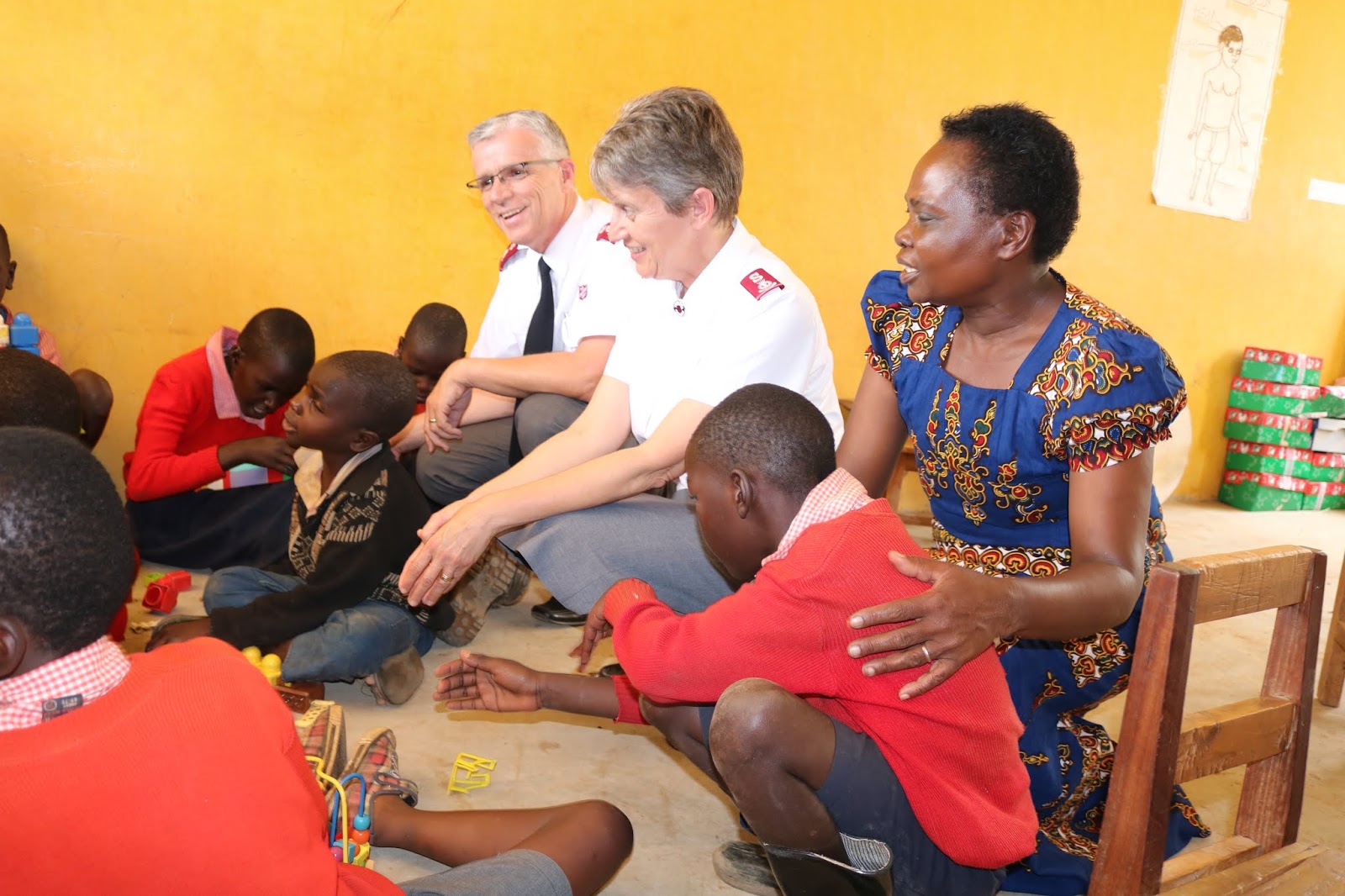
Our tour of the compound began by dropping in on the younger students. In a relatively bare classroom,10-12 first graders sat together on the floor having fun with building blocks. Sitting beside them, one child kept reaching out to hold our hand.  Some children were completely blind, others had a percentage of sight, some could not speak, and others had additional physical disabilities. “This little one arrived three days ago”, the teacher whispered to us, gently touching a sweet little girl on the back. “She was rescued and brought here.   We didn’t learn the details but I knew wherever this child had come from, being brought to this school was likely something better for her. I had rarely thought of a school as a place of refuge. How thankful I am The Salvation Army offers such a safe haven.  The playful interaction among these precious little ones was evidence they were being well cared for.  

Both the Primary and Secondary Schools are boarding schools.  In the boy’s dormitory, we met the ‘house father’ caring for both the older and younger boys who bunk together. Every bed was covered with a mosquito net and each student has a footlocker for their belongings.  It didn’t seem ideal for boys of such varied ages to stay in the same room. We were told the school is searching for assistance to construct separate rooms to accommodate the different age groups. 

Rounding the corner outside the dormitory, we met 20 high school students – again, some totally blind and others visually impaired.  The group was taken out of class to greet us and receive the gifts we brought.  As we approached, they were huddled together practicing items to present.  Once we were warmly welcomed, they sang a beautiful song with amazing harmony.  Joshua, the oldest in the class, had an incredible base voice and Joy, a bubbly and confident girl, was an obvious high soprano.  They quickly introduced themselves as ‘singers’ and told us about an upcoming competition. They were thrilled to have us listen to their song and grinned shyly as we applauded!  One girl recited a poem followed by another musical item with more singing plus dancing, accompanied by Joshua on the flute and another boy using an upside down water container for drumming. 

These students expressed themselves eloquently with their musical talents and speaking in clear English. Joshua, an obvious leader in the group, volunteered to say thank you on behalf of his peers when the braille machines were offered. “I thank God for these gifts” he said. “Now we can learn more and pass our exams. Please tell the sponsors how much this donation means to all of us here.”

Driving home, my heart was full of gratitude to have met these students, their teachers, and The Salvation Army Chaplains who provide Bible lessons each week. The pupils inspired us with their resilience to overcome limitations and disabilities, their courage and confidence in front of strangers, and their joyful spirits. They genuinely appreciated our time together and the gifts given from strangers in another part of the world. It was a meaningful example of being partners in mission.

At the end of the day, I couldn't help but ponder - is it possible that those who are blind, or visually impaired, can still actually see? I don’t mean physically (though some may view shadows or fuzzy images). But can those who are not as sighted as I am and you are, still ‘see’ in different ways?  In Dr. Barbara Brown Taylor’s book, Learning to walk in the Dark, she suggests when the sense of sight is missing, other senses are more pronounced.  Hearing and touch and smell can actually become like ‘eyes’.  Her studies about darkness revealed how the sound of different kinds of trees swaying in the wind can enable a person to distinguish which type of tree it is without seeing it.  And what about touch?  Taylor tells of a blind person who proposes “to feel a table is a much more intimate activity than seeing it. Run your hands across the top and you can find the slight dip in the middle of the center panel that you might otherwise have missed, proof that this table was planed by hand.”   

In the Bible, we read that God often appeared in dark places. He spoke to Abraham in the dark of night. The evening sky was key to Abraham’s trust in God.  Jacob wrestled with God after the sun went down.  The Israelite’s exodus from Egypt happened during the cover of darkness and manna was supplied during the night time. Jonah spent three days in the dark belly of a whale, while Paul spent three days blind in Damascus.  On Mount Sinai, God’s glory came to Moses in a cloud of darkness.  Is it possible that darkness, perhaps even blindness, can be a source of spiritual revelation?  To see may mean more than just physical sight.  In John 9:39, Jesus makes a statement that may seem strange ‘til we probe it a little.  “I came into this world for judgment so that those who do not see may see, and those who do see may become blind.” (Might need a full exegesis of the text to tackle the depth of that comment).

I make no assumptions about the experience of a person who is blind or visually impaired.  I do remember a very jovial man in one of our corps appointments who was almost fully blind yet he loved to play Santa Claus for the kids every Christmas!  As for the students of Mitoto, they sure energized us with the buoyancy of their spirits. They helped us remember that physical sight is a precious gift and so is tenacious determination when darkness falls.  I may never forget one of the students greeting us warmly: “Welcome to our school. It’s nice to see you today.” 


Presenting the new braille machines 


Two of the teachers 


Grade 7 class using machines


Grade 7's introducing themselves to us 


Primary class


The sense of touch is also a great way to learn. 


Grades 5 & 6 


High School students 

Gospel dance with flute and drums 

Joshua says "thank you so much!" 

Wish you could hear them sing!


Group photo with our Social Sponsorship Secretary and School Chaplain 


Sunday, 27 May 2018

Deep and Wide


Deep and Wide

Sunday School choruses keep surfacing as I blog. They are simple, visual, memorable.  This one has an expanded meaning for me now while still easy enough to teach our little granddaughter.
Deep and wide, deep and wide, there’s a fountain flowing deep and wide … (not the same without the actions!)   While this childhood tune describes the love of God, it also evokes other images of measurements and dimensions - width and depth. Images of an ocean or the sky may emerge.  Something large and grandiose. Something significant or striking.

When we were appointed to serve in The Salvation Army Kenya West Territory, it was thrilling to learn about the size of the Army here.  The SA yearbook records more than 125,000 senior soldiers, over 500 corps and 900 outposts.  The percentage of Christians in Kenya (those who claim Christianity as their faith association) is 80+% of the population.  I must be honest, I was impressed.  Before leaving home, I spoke about this to an officer whose brother had served in another country in Africa for many years. I was cautioned to consider not just the ‘width’ of church growth but the depth.  (This does not apply only to the church in Africa but anywhere.)  Over the past year, God has reminded me that large numbers of people participating in church life and claiming to be a follower of Jesus is only meaningful (or impressive) if they reflect the depth of what is truly important in the Kingdom of God - life changing spiritual values that are embodied.  Ultimately God is the judge of that, though Scripture teaches true Christian disciples are identified by the fruit of their living.

Morris and I recently visited two Corps where a ‘growing church’ was celebrated. Lusalanga Corps in the Musudzuu Division was upgraded from an outpost to a Corps. (An outpost is a smaller group of people who are part of a larger congregation but gather separately for worship, usually because of distance).  An outpost can become a Corps when financial and personnel resources are sufficient to operate independently as a stand-alone congregation. This was now true for Lusalanga.  After being a worshipping congregation for many years, the people had finally achieved the Territorial criteria for Corps status.  They have more than 200 senior soldiers, more than 50 Junior Soldiers, an active Home League (women’s ministry), a group of faithful local officers, a quarters for the Officer to live in (if they have an officer), a Corps building, and financial resources of at least 15,000 Kenya shillings ($150US) per month.  (Note: this criteria is now under review since a single Officer’s salary is 21,000/= ($210US) per month, plus other expenses for the Corps).  Currently, an officer has been appointed to serve part time here. The ‘mother corps’, Butisi, from which Lusalanga was birthed, is led by an Officer couple. The female officer will be leading Lusalanga while her husband remains at Butisi. 

 Vibrant and joyful worship was visible both outside and inside the hall that morning. More than 100 soldiers were marching to the corps, after conducting an open air meeting in the market, when we arrived. They welcomed us warmly and shouted in unison when Morris cut the ribbon at the door of the church.  They entered their ‘new Corps’ sanctuary with traditional dancing, singing, and drumming.  With the new Corps flag waving like it had wind in its sails, the congregation applauded loudly when the CSM was handed the framed certificate, naming Lusalanga as Corps #531.  Members of other outposts and neighboring corps were present to support the celebration as well as a gentleman from the Africa Divine church whose grandfather had been one of the first soldiers of the Lusalanga outpost from its inception. He even marched with the soldiers and saluted us! The Divisional Commander, who was present that day, gave a public appeal to have a full time officer appointed there in the next annual general change. Morris couldn’t make any promises so he just nodded. J At the end of the service, Morris was presented with three gifts to inaugurate him as an official elder of the Corps. He received a Masai blanket as a symbol of an elder’s responsibility to keep the people comforted, a club for him to defend his people, and a stool for him to rest when he was tired. An honorary moment.

A week later, we attended the grand opening of a Corps building in Chebosi, part of the Webuye Division. (I like sharing the different names of corps and divisions!). Chebosi has been a growing corps with five outposts.  They demolished their old corps building and worshipped at a school while raising funds for the new hall. They were so delighted to finally have their new structure.  The floors are still unfinished, the windows have no glass, and the walls are without paint, but the exuberant gratitude of the congregation that morning would match any.  It was contagious!  With visitors and members of the outposts joining for worship, the hall was almost filled to capacity – probably 5-600 people, and the crowd was ecstatic with joyful thanksgiving, expressing their praise and worship so freely.   The corps choir graced the worship time with melodious voices singing a beautiful rendition of “Lord I make a full surrender”.  Later in the service they were elated when one of their corps members (now a politician) donated uniforms for the entire choir.

Presenting the title deed for the land that morning also solicited shouts of gratitude.  This document confirms the Salvation Army’s ownership of the plot and is often very difficult to attain, due to corruption. It is essential for the corps to have this because of the challenge of ‘land grabbing’, thus the boisterous applause when it was passed over to Morris for safe keeping at THQ.   

When we make such visits as these, we don’t pretend to know whether the ‘width’ of the church growth is congruent with its depth. However, in both these situations, it was the devoted service and locally owned initiatives of the people that helped achieve the growth they experienced. The members of the church had been faithful in attendance, in evangelism, and in giving (many sacrificially) for a long time in order to accomplish their goals. They did not depend on Divisional or Territorial Headquarters for reaching these milestones which indicated a commitment that was about more than just numbers. I remembered one of General Andre Cox’s “I dream” statements, released during his first year in office.
 “I dream of an Army free from the dependant culture”. This may not be true in every corps in Kenya, or around the world, but it is worth celebrating when we see glimpses of it.

Jesus told many parables related to growth in the Kingdom of God that began with something very small - a grain of mustard seed, a pearl, a tablespoon of yeast, but it grew – and the outcomes were a mighty tree, a vast treasure, an expanding influence.  Lusalanga and Chebosi began as a small Army but through perseverance and dedication, an organic spiritual community has emerged. We pray the growth in these churches will be equally deep as they are wide.

I long for a church in Kenya and universally that not only records large numbers of people attending, but is rooted deeply in its spiritual life. I resist the temptation to boast of any growth that does not reflect Kingdom values. Actually, I must resist boasting altogether.  Instead, I reach back in time to a couple verses from the first chapter of the Bible I ever memorized, Psalm 1. (I guess I learned more than choruses in Sunday School).  “Blessed is the one whose delight is in the law of the Lord. That person (or church) is like a tree planted by streams of water, which yields its fruit in season.” (brackets mine)

So grateful that Morris and I have seen (in many places over the past 24 years) some of the fruit being yielded in season and for that, we give God thanks.

Hope you enjoy a few pictures of our corps visits.  


Lusalanga Congregation marches from the open air to the Corps 


They gather outside for prayer before the official opening 


They are so eager to enter the building to celebrate becoming a corps!


But first the plaque must be unveiled ...


And then the ribbon cutting!


Finally they fill the hall!! 


So happy with their new flag! 


Corps number 531! 


Thanks Chief - you're one of us now! :) 


Chebosi Corps marches to receive the salute of their Territorial visitors.  


Corps Officers and Divisional leaders are very excited today! 


Planting trees are always are great way to celebrate growth!


Morris shares a few words before the doors open.


And again, the plaque is unveiled 


You just had to be there to experience the joy!!


One base drum is never enough - a great African tradition. 


The group standing back on is the Corps choir. They sang so beautifully! 


Hip, hip, hooray for a title deed!!


And the presentation!


A wonderful day! 


Tuesday, 15 May 2018

Family Visit


Family Visit – April 2018
Living and serving in another country is a privilege, a blessing, a stretch, and an education. The hard part is being far from family.  We are extremely thankful some of our family have been able to make the long trek to visit us.  On April 18, we drove to Kisumu airport to welcome Erica and Jeff and two very sleepy toddlers to our new home! We spent two and a half weeks relishing the joy of having Anna-Lynne and Oliver, and their parents, with us.  Capturing much of our time on camera (see pics below) we explored some of Kenya’s natural beauty and wonders including incredible wildlife and brilliant scenery like the distant view of Mount Kenya emerging above the clouds. Spectacular!  It was neat to have our family see for themselves the landscape and the culture we have tried to describe. Travelling around the places familiar for us, they now have their own visions of the uniqueness of this country and the innovative, resilient people who use available resources to build their lives every day, and often do it well. I believe this added much to their holiday.

While we planned some excursions especially to amaze our young grandchildren with marvels like the big five, there was no question the four adults in the group were equally delighted.  We spent two days at Ol Pejeeta Conversacy, about four hours drive from Nairobi, staying at the Serena Camp inside the game park.  The early morning sunrise game drives gave us many up close sites of zebras, impalas, buffalo, rhinos, elephants, jackals, gazelles, hyenas, and water jacks (part of the deer family). All truly remarkable creatures! We also stood on the imaginary equator line and for a just a few minutes, spanned two hemispheres. :) 

The Serena Camp was tenting at its finest. Not exactly roughing it!  Along with very comfortable, hotel like tents, it had a beautiful dining room where we could watch rhinos come to the watering hole just outside our tent and be entertained by a large stork that kept wandering up to the window by our table. 

The only little ‘slump’ in our safari visit was our matatu (van) getting stuck in the mud the day we left. Spending four hours watching the locals try to pull us out taught us patience (I think) and the reminder of being prepared for the unexpected. It was probably an exciting morning for the neighbors!

Along with getting to feed a special rhino who was blind named Baraka (he sure loved sugarcane), we also fed giraffes at a park in Nairobi. (The option to kiss the giraffe was available to us but we declined!) We had a good history lesson though and were intrigued to learn about preserving certain species of these very tall animals.

Later the next week, we enjoyed time at Rondo Retreat Centre in the heart of the Kakamega rainforest. We were thrilled with watching the jovial play of both the blue monkeys and colobus monkeys (they look like skunks with a white stripe down their back and tail).  Got some close up photos one day of them racing through the grass.  This area is also home to the splendour of gorgeous butterflies and amazing floral. Erica and Jeff did a two hour guided walk through the rainforest and climbed the mountain for the panoramic view of just how large the rainforest is. The grandparents had fun with the kiddies alone for a few hours. Love it!  

One day we drove about 30 km from our house for the kids to see some entertaining baboons.  It was fun watching them play together, wash each other, and eat their sugar cane.  Apparently many animals have a sweet tooth just like us.  It was a little unnerving when the baboons came close to the car but not alarming.  They are obviously quite comfortable living by or on the busy road. 

Another treat for us was celebrating Oliver’s first birthday. The little guy liked his new African drum. J We also had opportunity to worship with our family at two corps – Kakamega Citadel and Ikonyero corps where we soldier. The happy (and loud) singing, dancing, and drumming was a little different from most Canadian worship services – happy we got to share it together.  At one point, Anna-Lynne joined her Nana and Granda on the platform when we were called on to pray. We hope all these memories stay with her.


A few shots of this precious family holiday: